Why the Next Generation of Yacht Clubs Is About More Than Boats
For generations, the formula for a yacht club was fairly straightforward.
Find a desirable piece of waterfront. Build a clubhouse. Add docks, a dining room and a bar. Establish a sailing program. Hang a collection of burgees on the walls and fill the calendar with regattas, holiday dinners, and enough longstanding traditions to ensure that new members understood they had joined something with a history.
It was a formula that worked remarkably well. And in many places around the world, it still does. But spend time around some of today’s most desirable waterfront clubs, and you’ll notice something changing.
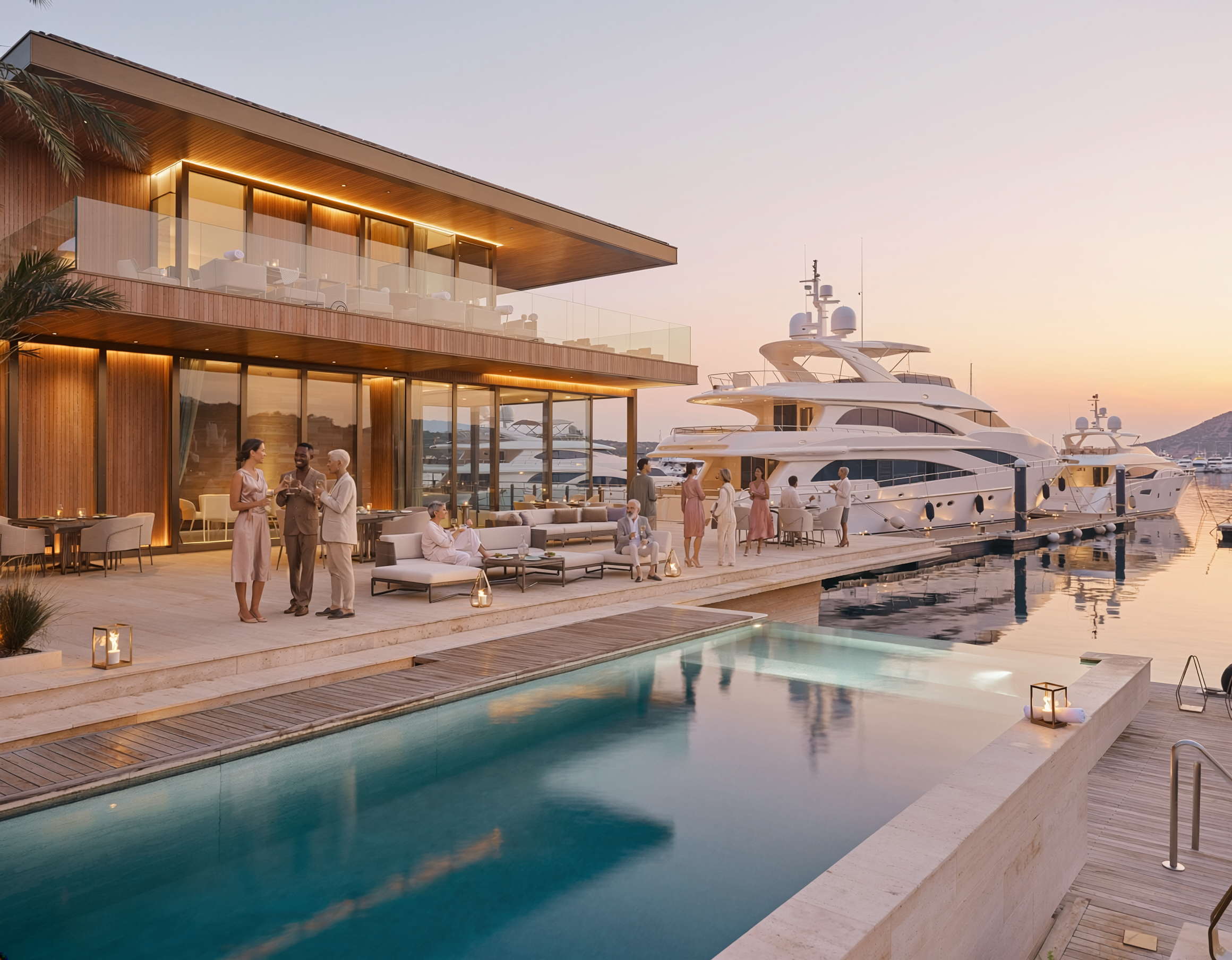
The pool looks more like something you’d find at a five-star resort. The club restaurant has become somewhere members would actually choose to dine even if they weren’t members. The fitness room has evolved into an entire wellness program. There are private beaches, cabanas, pickleball courts, DJs, children’s activities, and social calendars designed to keep members engaged whether or not they have any intention of leaving the dock.
Welcome to the age of what we might call the Yacht Club 2.0.
The Yacht Club Was Always About More Than Yachts
Of course, there is an obvious question behind all of this. If you already own a beautiful yacht, why do you need another place to sit beside the water? Well, using a yacht and belonging to a club satisfy different needs. The yacht gives you freedom, while the club gives you membership and resources.
To better understand why the yacht club concept is changing, it’s worth remembering what made yacht clubs successful in the first place. Per the name, of course there are the yachts. But the best clubs were always about something less tangible: belonging. Membership has an inherently luxurious feel, and yacht clubs pandered to that emotional prestige to the utmost.
They gave people with a shared interest a place to gather. Owners traded cruising stories at the bar and families spent weekends around the club while their children learned to sail. Members raced against one another on Saturday and had dinner together Saturday night. The boats created the connection, and the club gave that connection a home.
What has changed is what affluent members expect that home to provide. Today’s yacht owner may already belong to a country club, fitness club, beach club, or private social club. They stay at exceptional resorts and dine at exceptional restaurants. They may have a beautifully designed waterfront home and, of course, a yacht that is itself an extraordinary private hospitality environment.
A clubhouse with a decent dining room and a swimming pool is competing against all of that, so the modern yacht club is being asked to do more.
From Yacht Club to Waterfront Lifestyle Club

The clearest examples of Yacht Club 2.0 begin with a slightly different question than their predecessors. Instead of asking, What facilities do boaters need? They ask, How would our members actually like to spend the day?
That subtle change produces a very different club. Picture the following day: You arrive at 9 a.m. for a workout. Your spouse meets friends around the pool. The children have an activity later that morning. Everyone reconvenes for lunch, then you take the boat out for a few hours, shower and change, then stay for dinner.
Or…perhaps you never even take the boat out at all. Ironically, that may be evidence of a very good yacht club.
The New Luxury of Connection & Wellness
There is also a larger shift underway in luxury. Privacy still matters enormously. Few groups understand that better than yacht owners. Still, privacy and isolation aren’t the same thing.
Increasingly, the desirable combination is privacy with access to community when you want it. That’s precisely what a private club can provide. You aren’t walking into a random resort pool or hoping to recognize someone at a restaurant.
You begin seeing the same people. The bartender remembers the drink. All of those subtle reminders that social connection remains accessible even for those in the ivory tower of superyacht ownership. That’s an extraordinarily valuable position for a hospitality business to occupy.
Luxury hospitality has become increasingly wellness-oriented, and yacht clubs are following. Porto Montenegro’s sports offering includes tennis, squash, gym facilities, yoga, Pilates, personal training, group fitness, and massage therapies. Club de Mar’s new complex incorporates both a gym and spa.
It reflects a broader change in how people with the luxury of discretionary time increasingly want to spend it. A club that once expected members to arrive at noon for lunch now has a reason for them to arrive at eight in the morning for coffee and a workout.
But are they all the same then? What distinguishes one yacht club from another?
Start taking a look, and you’ll quickly see different versions of this idea emerging on both sides of the Atlantic. Let’s explore a few of the top Yacht Club destinations in the world.
A Peak at World Class Yacht Clubs

The Beach Club & Yacht Club at the Boca Raton
When the Yacht Club Starts Feeling Like a Private Beach Club
The Boca Raton offers a distinctly resort-driven interpretation of the modern yacht club, where the marina is less a standalone amenity than one part of a much larger luxury lifestyle. Members and resort guests can move between the waterfront, private beach, pools, dining, spa, golf, and the broader social scene without the traditional boundaries that once separated yacht clubs from luxury resorts.
That integration is what makes it particularly relevant to the Yacht Club 2.0 conversation. The appeal isn’t simply having somewhere to dock the boat. It’s being able to arrive by water and step directly into a polished resort environment where an afternoon aboard can transition naturally into drinks, dinner, the beach, or an overnight stay.
For yacht owners accustomed to luxury hospitality on land as well as on the water, The Boca Raton illustrates where the category may be heading: less emphasis on the clubhouse as the center of everything, and more emphasis on creating an entire waterfront lifestyle around the marina.
The San Francisco Yacht Club — Belvedere, California
Modernize the Experience, Not the Identity
At the opposite end of the spectrum are traditional institutions that have no reason to abandon what made them special. The San Francisco Yacht Club is a useful example.
Founded in 1869, it is the oldest yacht club on the West Coast. Sailing, racing, boating, youth programs, and nautical tradition remain fundamental to the club. And that’s important.
Yacht Club 2.0 shouldn’t mean turning every yacht club into a beach resort with a DJ. For established clubs, the more interesting question is how to make the lifestyle surrounding serious boating more compelling.
The club has expanded its hospitality and event spaces, including waterfront dining and the Cove House, a newer gathering and events facility overlooking the harbor. The point isn’t to replace the regatta with brunch, but rather to create a club where both belong.
That may ultimately be the smarter evolutionary path for many established American yacht clubs: preserve the traditions that give the institution meaning while upgrading the parts that determine how frequently members actually use it.
Yacht Club de Monaco — Monaco
When the Club Becomes Part of Yachting Culture Itself
Ah yes, then there is Monaco. Yacht Club de Monaco represents a different version of the same evolution because it doesn’t need to turn yachting into a lifestyle. In Monaco, yachting already is the lifestyle.
Its Norman Foster-designed clubhouse overlooking the famous Port Hercule functions as far more than a place for members to dine after sailing. The club occupies a central position within Monaco’s yachting culture, bringing together sailing, superyachts, events, education, sustainability, business, hospitality, and social life.
That’s a useful reminder that Yacht Club 2.0 doesn’t have to mean adding enough amenities to resemble a resort. It can also mean expanding the role the club plays in its members’ lives and within the larger yachting world.
Club de Mar-Mallorca — Palma, Spain
A Multi Million Dollar Bet on the Future of the Yacht Club
Perhaps the clearest evidence that this evolution is more than a passing hospitality trend can be found in Palma. Club de Mar-Mallorca has been part of Mallorca’s yachting landscape for more than half a century. Rather than just resting upon that history, the club has recently undergone an enormous transformation.
Its redevelopment created four interconnected buildings incorporating members’ areas alongside restaurants, a gym, spa, multipurpose rooms, event spaces, retail, marina facilities, and contemporary waterfront public areas. The latest phase also adds three restaurants and 25 commercial spaces, highlighted by nautical boutiques and Mediterranean lifestyle offerings.
The dining strategy is particularly telling. Instead of treating food as an obligatory club amenity, Club de Mar brought in established restaurant operators. New concepts include a members-area restaurant, casual waterfront dining, and a revived Mar Salada designed to evolve into a sophisticated late-night social venue.
Think about that for a moment. A historic Mediterranean yacht club now considers the quality of its restaurant operators, spa, gym, retail mix, nightlife, architecture, and social spaces important enough to form part of a major redevelopment.
And importantly, Club de Mar hasn’t abandoned its nautical identity in the process. The club continues to host regattas and reserve private areas for members while simultaneously opening parts of the redeveloped waterfront more closely to Palma itself.
That’s Yacht Club 2.0. The boats matter just as much as ever, but the experience surrounding the nautical lifestyle has morphed into something else entirely.
The Final Anchor Point

The modern yacht club isn’t simply competing with another yacht club for members. It’s competing with all the clubs. Think beach club, country club, private social club, even the five-star resort. Most challenging of all, it’s competing with the member’s own yacht.
That’s a very high bar. A yacht owner accustomed to exceptional service, thoughtful design, and memorable hospitality isn’t likely to suspend those expectations when stepping onto the dock.
Successful modern yacht clubs are building on what made them special in the first place. Some are expanding their facilities, wellness offerings, and social calendars while preserving genuine yachting heritage. Others are pushing much further, evolving into destinations that encompass an entire luxury lifestyle.
Different places take different approaches, but they increasingly point toward the same idea. The yacht still matters. The club still matters. The traditions still matter. Increasingly, so does the lifestyle.
That helps explain the renewed facilities, amenities, and increasingly ambitious social calendars. They’re not simply extras added to make a club more impressive. Together, they extend the nautical lifestyle beyond the yacht itself and give members more reasons to remain connected to the waterfront.
The future of the yacht club isn’t simply about where you go when you leave the yacht. It’s about giving you a good reason to leave it in the first place.
Boat Confidently.
Remember to sign up for the Boat Rankings Newsletter.
This site is informational in nature and any information or advice should be considered accordingly. You should make your own investigations with respect to the suitability of goods and/or services offered to you via a Linked Website. The information presented on this site are opinions and should not be taken as endorsements (except where specifically stated) or business affiliations with any of the respective brands or business entities named anywhere on this site.
This content may include affiliate links from advertisers. It may earn a commission from actions readers take on these links (at no cost to you), such as a click, purchase, or subscribe. As an Amazon Associate I earn from qualifying purchases.
Trademarks, logos, and other identifiable depictions of any brand or business entity are owned by the respective entity. BoatRankings uses manufacturer-provided or authorized imagery when available. When authorized photography is unavailable, original BoatRankings editorial artwork or graphics may be used, which may include AI generated or edited images that do not reflect the actual product(s). Imagery availability has no bearing on rankings or scores.


Leave a Reply